Gardening tips for Southwest New Mexico

spreading-lantana-imageLantana plants – Should be starting to show signs of life.  If you cut them back during the winter season…good.  If not you can still cut them back now and check towards the bottom of the each plant.  Look for smaller green foliage.  Yellow gold or trailing Lantana are very hardy.

Verbena should show signs of life during the mid part of April.  The purple homestead should be blooming by now. If not continue water the area and should respond by the end of May.


red-bird-paradiseRed Bird of Paradise is another great colorful plant however – it likes heat…and lots of it.  You should start to see signs of life in mid May if not – increase water usage.


california-fan-palmFan Palms – The California fan palm should have new fronds right dead center of your tree.  You should prune off the older lifeless looking fronds.

Got questions about “Gardening Tips for Southwest New Mexico”?  Ask or post your comment below.  We would love to hear from you.


Photos of borer damage on trees

borer-damaged-trunk
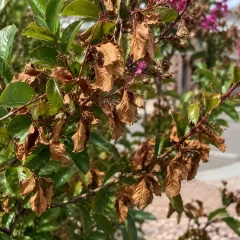
Have you ever wondered what borer damage looks like?  Will borer’s kill a tree?
Yes they will. Check out the photos of borer damage on trees photo on the left.

First we must know what a borer is?
Borers are the larvae of different species of beetles and moths.

Most will lay their eggs on tree bark, or limbs of your fruit or ornamental trees.

Just like in football your best offense is to have a good defense. Use dormant oil spray in early spring and late fall to prevent insects including borer larva from infesting your trees.

Dormant oil is a refined oil, it goes by other names…insecticidal, horticultural, or range oil. What the oil actually does is smother the insects in the early stages of it life cycle.

Spray your tree with dormant oil in late fall, and early spring for best results.  It is important to note that this oil is a preventative measure not a cure.

Another preventative measure is to have a regular watering and feeding schedule.  Trees like people are less likely to experience diseases or health problems if they are healthy.

What If you already have borers? border-damaged-tree

If you see evidence of borers it’s time to eliminate them.  Bayer’s Tree and Shrub Insect control ™ works wonders and should be applied asap.

Do not let the “Insect Control” part fool ya…it will kill anything living inside your tree including aphids, worms, larvae, mites, and other insects.  It will not kill ants as they are not taking in or eating wood.

It will also kill the Asian long horned beetle – which is common in the southwest.  It also kills the cottonwood and pine wood sawyer borers which are native to New Mexico.

The Emerald Ash borer is another one that is not so common in the southwest but still a problem.

What about Fruit Trees?

Bayer’s insecticide should not be used on edible type fruit trees or shrubs.  Obviously the fruit will contain some of the poison (imidacloprid) used to kill borders and insects.  That brings us to “What do we use for fruit trees”.

The obvious answer is to do the dormant oil as mentioned above as a preventative measure.  Bayer’s label instructions does include using it’s product for the following fruit trees – apple, crabapple, loquat, mayhew, oriental pear, pear,  pecan and quince.  It does not mention peach, fig, citrus and cherry trees.

If you have questions about this product please contact us here: Contact Us.

  • It is important to read and follow all label instructions before using this product.
  • Imidacloprid is also called MERIT.  Research this product.


Do you have comments or questions about our “Photos of borer damage on trees” post?  Let us know by commenting below.


How to fertilize for best results

more-blooms-green

How to fertilize for best results

Do you want colorful great looking plants, flowers, vegetables and lawn just like the photo above?  Of course you do.  So…how does someone get these kind of results? You setup a good water and fertilizing schedule.

First we need to know what is fertilizer

All plants need 3 natural occurring elements that come from the earth.

  1. nitrogen – for green foliage
  2. phosphorus- Plants need phosphorus for blooms and sturdy stems.
  3. potash – over all growth of plants, trees or grass.

Without those elements your plants would not grow, flower or produce edible food.  They also need Sulfur, calcium, magnesium and iron.  These are macro-nutrients that are also required.  They also need water and around the desert southwest they need lots of it.  Even desert cactus needs some water in order for it to survive and produce flowers.

Typically all deciduous trees and plants should be fertilized in early spring, summer and once in fall.  For better results try fertilizing once per month starting in early spring just when things are budding out.  This includes ornamental and lawn type grasses.

You can also do the same for vegetables and herbs however it is wise to use water soluble fertilizers as plants will absorb them quicker.

What type of brand name fertilizers should you use?

Good question.  Miracle grows ™  all purpose fertilizer will help just about anything under the sun (pun intended) but sometimes you may need something that is not so general.

For more blooms try BR61 from Carl Pools™.  This fertilizer will give any plant whether it is a vegetable, ornamental or flowering type plant a good amount of phosphorus that is needed to get more blooms.

For plants or trees that are pale or appear to have yellow leaves I recommend adding iron into the soil.  Use IRONITE™ to get your plants or tree a greener color.

For stronger stems and over growth try Ferti Lome’s ™ Muritae of Potash.

For greener lusher lawn try Helena’s 16-8-8 as this lawn fertilizer will help any type of lawn grow faster and greener. This is only available in the Southwestern part of New Mexico. But anything close to that analysis will help your lawn.

When visiting your nearest retail nursery always ask for a fertilizer that is specific to your needs.  In other words ask them “I need a fertilizer for my vegetables” or do you have “Lawn fertilizers”.  Your plants will look better and might make you want to throw an outdoor party.

If you have any questions about “How to fertilize for best results” please give your comments below.

Types of grasses for the southwest

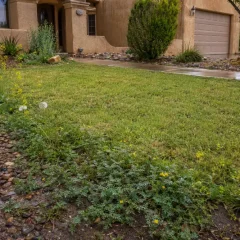
green-lawn-imageHere is a list of grasses that do well in hot dry conditions.   Grass in the Southwest tends dry out faster and drought conditions compound the problem. But there are some things you can do to keep it looking greener and healthier year round.

Types of grasses for the southwest

Common Bermuda – This type of grass is used because of it’s tolerance to heat, and foot traffic. It grows very fast and can be easily transplanted for repair purposes. Bermuda creeps and crawls thus making it an excellent choice for who are looking for fast ground cover. However it can invade flower, vegetable beds. Removing Bermuda is almost impossible and the root or rizome system is extensive and only needs a small amount of water and sunlight for re-growth.

Sultan and Sahara Bermuda varieties are also a good choice as these are very drought tolerant.  These grasses only come in seed form.

All Bermuda grasses tolerate drought conditions, foot traffic and poor soil.  It does not like shade so…planting it in shady conditions is not a good idea.  It requires at least 6 hrs. of sunlight.  We recommend a watering schedule about 2-3 times per week about 15-20 minutes on a sprinkler system.   Fertilize with a good lawn fertilizer (16-8-8 analysis).

It is important to remember all Bermuda grasses will go dormant in zone or places with temperatures consistently get below 32 degrees during the winter months.

Types of Bermuda Grasses (Hybrids)

  • Tifton – Coarse to medium textured leaves and can blend in with common Bermuda.
  • Tifway – Medium fine textured leaves dense and medium to low growth.
  • Tifgreen – Has fine blades with high density and dark green blades. Great for those looking for tight fine grass.
  • Santa Ana – Coarse to medium blades.
  • Celebration – Is a dark blue-green color with medium fine soft to the touch blades. (Not always available).
  • Princess 77 – medium-fine textured, dark green grass that has good heat and wear tolerance. Much more drought tolerant than all the rest and can tolerate more shade (Not always available).
  • All Hybrid grasses produce sterile seeds.  The seeds will not germinate.

Other types of Southwest grasses

Tall Fescue is a Medium-to dark blue-green colored grass with medium blades.  It does require much more watering and typically stays green year round.  We recommend watering every-other day about 20-30 minutes during the hot southwestern summers.  Newly planted seed or sod needs watering every day for about 2 weeks.  For better results water once in the morning and again in the afternoon.  This type of grass is ideal for those looking to have a green landscaped lawn year round.

Reveille – is a hybrid of Kentucky and Texas Bluegrass but looks and feels like Kentucky Bluegrass, however it is much more drought tolerant.  You can get away with watering about 2-3 times per week 15-20 minutes on a sprinkler system.  Water every day for newly planted sod.  Use a good lawn food (16-8-8 analysis).

Do you have any comments on types of grasses for the southwest?  If so please leave a legitimate comment below…we would love to hear your feed-back.

Bradford Pear white flowers in spring

The Bradford pear (Pyrus Calleryana ‘Holmford’) tree does very well in the desert southwest it is a deciduous non edible-bearing fruit tree.  It can grow to about 25 to 30 ft. tall and 15 maybe 20 ft wide.  Most folks use it as an ornamental tree because it is narrow and does not provide a lot of shade.

The growth rate is in-between fast and slow but you can make it grow faster by providing it with more water during it’s first 1-5 years of it’s life.  Once established it is a drought tolerant tree.  The root system is not invasive in the Southwest and can be planted in full sun or partial shade. It is a deciduous tree which means some maintenance during the fall seasons.

bradford-tree-imageTree that produces white flowers in spring

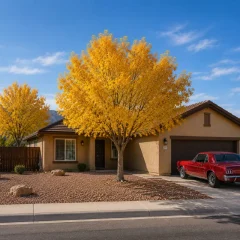
Yes, this tree produces white flowers in early spring typically around mid March to about early April.  The blooms are spectacular and will cover the entire tree.  After the blooms expire they will continue with green almost waxy like foliage.   For added color the leaves will turn a purple almost maroon color during the fall seasons.   It does produces a small pear like fruit (non edible).

What type of fertilizer should you use for this tree?

Use a good Tree and Shrub fertilizer during the spring, summer and fall seasons.  For faster growth and more blooms try fertilizing every month starting in mid March.  Ask your local nursery specifically for “Tree and Shrub Fertilizer”.  If they don’t have it…go elsewhere.

Is this tree susceptible to diseases or insects?

All living things are prone to diseases…but these trees are less likely to do so.  We should all strive to  prevent, delay or study ways to keep living things to flourish as long as possible.

Trees that come from Monrovia wholesale Nurseries are much less prone to diseases.  The thing to do is to observe your Bradford Pear tree throughout the growing season and follow a good fertilizing, watering schedule to help keep it healthy.

Borers might invade this tree but using a good systemic borer control solution will ensure they die before they can damage the tree.

If you live in the desert southwest and are looking for a good ornamental tree that has good spring and fall color I would recommend this tree.


Bradford Pear White Flowers in Spring

Do you have questions or comments about this tree?  Let us know by giving a legitimate comment below.


A wordpress install assisted by technofreak